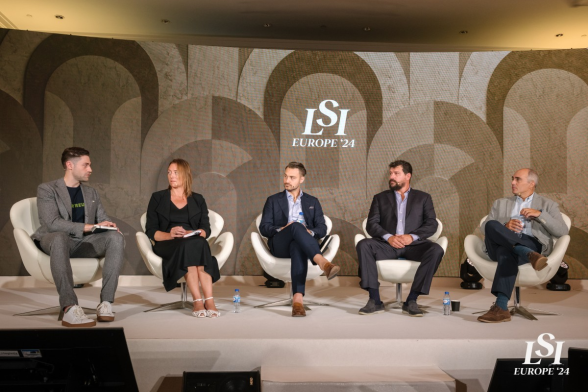
Acquiring funds is among the largest hurdles an entrepreneur will encounter; however, acquiring funds from family offices necessitates a different strategy. This message was clearly articulated on a high profile panel at LSI Europe that discussed the special benefits and subtleties of working with family offices compared to traditional med tech venture capitalist.
The event was led by Alexei Mlodinow (a former CEO and co-founder of SIA), and featured Marie-Louise Little (TW Medical A/S), Tyler Wanke (Wanke Family Office), John Slump (Atraverse Medical) and Pablo Prieto (CG Health Ventures), who shared some honest and pragmatic insights about developing trust, managing timeframes, and establishing the types of connections that will ultimately allow medtech companies to secure transformation capital: to support the development of medical connected devices that communicate with each other as well as “next generation” solutions.
Building Trust Before the Term Sheet
Relationship Building is the Core of Capital Raising from Family Offices
“Family Offices Rely on Their Networks for Deal Flow,” says Prieto. “90-100% of Our Deal Flow Comes from Existing Relationships (Co-Investors or Other Family Offices). It can be Challenging to Break into This System from the Outside.”
This has a more direct meaning for founders, as they cannot expect to build relationships after they have begun their fundraising efforts. According to Wanke, “Trust is built through doing deals and getting to know people. Many times, we do not give money to companies that we have never met before. If you have been to a conference, such as the LSI Emerging MedTech Summit, and have delivered on what you said you would do in the past, we will have formed a level of trust.”
Mlodinow was of a similar opinion: ” Fundraising is a difficult business. For first-time founders it’s about the team and tapping into other networks. The initial way you might get into family offices is from the board, a hired executive or through someone who knows that network.”
And after the relationship is established, the deal terms can differ dramatically. “I’ve never had a family office suggest using a participating preferred structure,” Slump commented. “However, many VCs follow a very similar approach. There is a much greater flexibility with these deal terms.”
Navigating the Dynamics of Family Office Capital
Family offices generally lack strict investment mandates-which can make them seem somewhat erratic to founders who are used to thesis-driven institutional funds-but it can be one of the fund’s strengths if you can read the room.
“Asking a family office for its ‘mandate’ does not make sense necessarily,” Mlodinow told us. “Better ask about its bias. Which therapeutic areas are dear to it, what kinds of founders does it back?”
Agreed Wanke: “We do not have a mandate, but we have passions, such as we have done multiple deals in women’s health and breast cancer. Also, neurodegenerative diseases is an area of high importance to our family office, mainly due to our personal experience.”
Little noted the aspect of proximity for more hands-on investors: “Being based in Copenhagen makes it easy to spend time with our companies that are local. Yet, we are investing in U.S. Based companies too, so we can learn a lot from them as well.”
Family offices should be attractive partners for those developing on the confluence of devices and digital health, and the medical connected devices space in particular, due to their love of the long horizon and their desire for customized solutions in personal health.
Explaining why the bulk of Prieto’s portfolio is on this side of the pond: “Sixteen out of twenty of our active companies are there. The returns are easier to realize. Scaling out of Europe is costly and complex. There are twenty countries; twenty different health systems. In the US, there are more experienced founders and better exit events.”
Despite the adaptability, family offices don’t invest on a whim. “We have become quite professional,” Little claimed. “When I joined there were no structures – just trust. We now do KPIs and governances, while we are still fundamentally different from a venture capitalist; it is about adding discipline.”
Patience, Permanence, and Portfolio Strategy
Perhaps the biggest difference between VC funds and family offices is that there is absolutely no time constraint. There is no fund life cycle. No exit timing pressure forcing hasty choices.
“Eight or nine years? Totally okay for us,” says Slump. “We’re happy to be on the cap table for eight to nine years, as long as the business is doing well. We invested in Virta Health in 2016 and we are still in that today in 2026, very happy.”
Wanke provided Endotronix as an example of patience yielding great returns. “It was a 16-year or so life cycle. It’s a story where the business could have died several times, but the family office got involved and kept it alive. The difference is unbelievable. Patience makes a huge difference.”
Slump told another story of a company, Tune Medical, growing to $22M revenue on an annual basis over 15 years before being sold for $160M. “It was a long one, but the upside was huge, which a family office can give you.”
And patience is a two-way street. “You might get a fast exit opportunity, a 3x in 18 months,” Wanke noted. “VCs might pass over that because it’s not a large multiple. But for us, we get an attractive IRR. We’re agile.”
When looking at a portfolio, there’s a willingness to adjust. “We’re not operating off of a rigid roadmap,” said Little. “But we’ve gotten better at having real intent. It evolved from investing in people we liked, to being more structured in how we make decisions.”
Wanke pointed out that a good working relationship with founders leads to future investments. “We’ve invested after entrepreneurs moving into different disease areas, just based on trust. If they have a track record, they can pull us into their next opportunity.”
Lessons for Medtech Entrepreneurs
The key takeaway for founders interested in family office capital was straightforward:
- Begin relationship building in advance: Avoid waiting until you’re in active fundraising to approach investors. Demonstrate consistent presence, at medtech conference Europe series, and follow through on promises to build trust.
- Be aware of personal drivers: Most family offices invest based on the family’s values. Thoroughly research and be ready to explain why your mission would align with those principles.
- Remain flexible and transparent: Clearly articulate a value proposition, while remaining open to change. Seasoned investors know that roadmaps are unlikely to stay exactly as planned.
- Utilize trusted connections: Board members, recruited CEOs and other professional contacts are far more likely to open doors for you than unsolicited emails.
- Think long-term: If you’re looking for a quick flip in medtech, family offices are likely not for you. If you’re developing something substantial in areas like surgical robotics, diagnostics, and medical connected devices, family offices are peerless partners.
Conclusion: A Different Kind of Partnership
So to win family offices is not simply about term sheets it is about alignment. They are not working to a fixed timeline or to an institutionally imposed mandate. They are working with people, for a purpose, with a promise of creating long-term value. For the medtech entrepreneurs making meaningful products, family offices provide a deeply human-and very strategic-avenue for scaling your ventures. The best place to start building those relationships is at the LSI Emerging MedTech Summit, the place every year where the entrepreneurs and investors shaping the future of medtech meet.
Looking to connect with the investors and innovators defining the future of medical technology? Come on board for LSI Europe – Europe’s leading medtech conference.
